Interpreting Premonitory Dreams: Understanding the Signs Without Jumping to Conclusions
Interpreting Premonitory Dreams: Understanding the Signs Without Jumping to Conclusions
A vivid dream can feel like a glimpse of the future, but interpreting premonitory dreams requires discernment. This article helps you examine dream context, emotions, and possible explanations without mistaking coincidence for certainty. Learn to keep a dream journal, distinguish intuition from hindsight, and explore personal meaning with a grounded approach. If a dream raises a personal question, a confidential psychic chat reading on Breeve can offer a space for reflection while you keep your own judgment.
Published on:
8/10/2026
Can a dream predict an event, or does it simply resemble it once it has happened? After a vivid or recurring dream, the coincidence can be unsettling and make you want to search for its meaning. Interpreting premonitory dreams, however, requires leaving room for doubt: a strong impression is not enough to prove that the future was predicted.
Some dreams seem surprisingly close to what happens later. They can also mix details noticed without paying attention, current concerns, and strong emotions. When you revisit them afterward, you may find a meaning that wasn't obvious upon waking. This doesn't minimize what you felt, but invites you to distinguish between intuition, memory, and interpretation.
In this article, you'll discover why a dream can seem premonitory, how to examine its context and the emotions it stirs, and how to use it as a starting point for reflection without taking it as a certainty. If this dream raises a personal question, a private psychic chat reading with a certified psychic advisor can also help you explore your feelings, while keeping your own discernment.
Key Points
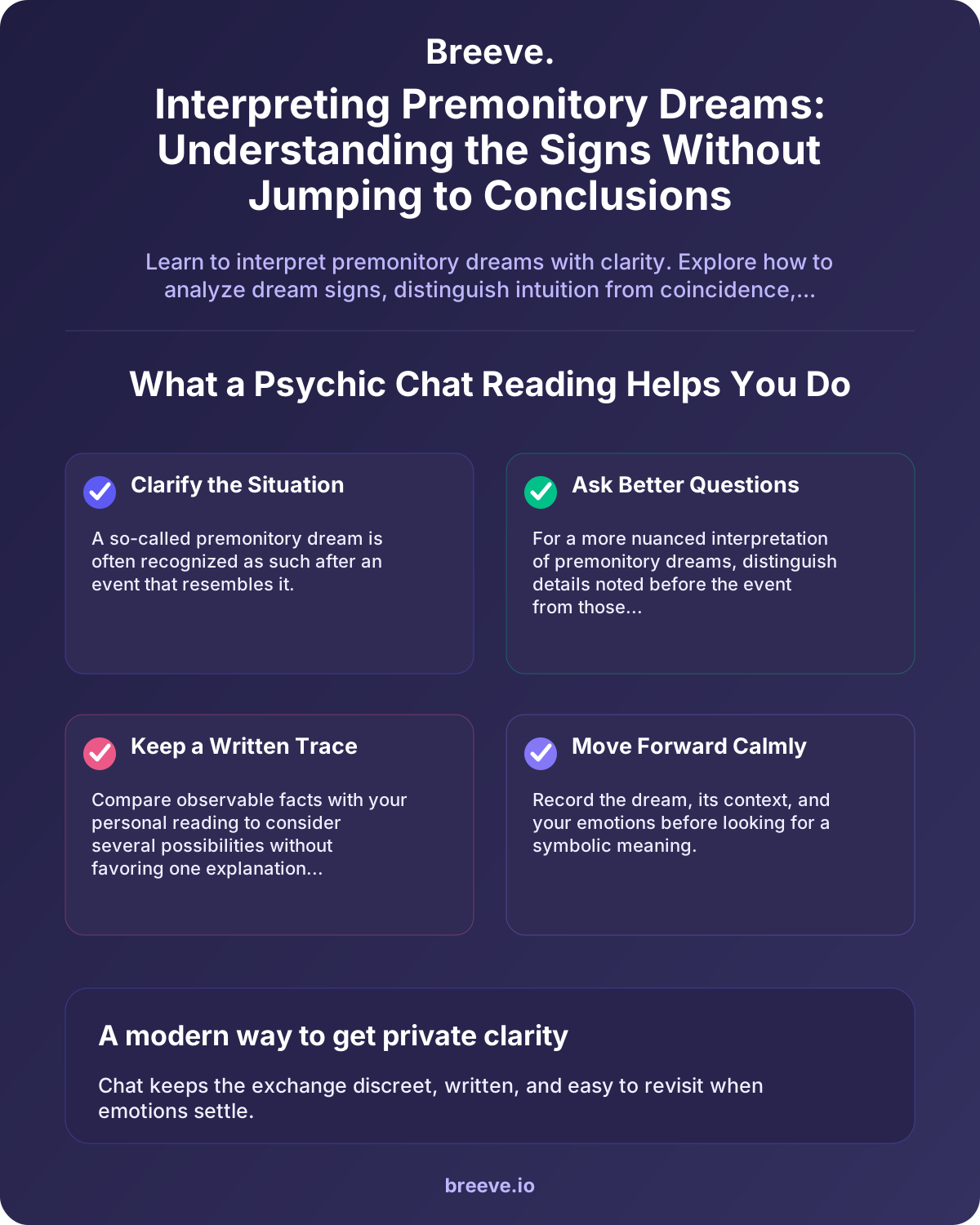
A so-called premonitory dream is often recognized as such after an event that resembles it.
For a more nuanced interpretation of premonitory dreams, distinguish details noted before the event from those reconstructed afterward.
Compare observable facts with your personal reading to consider several possibilities without favoring one explanation too quickly.
Record the dream, its context, and your emotions before looking for a symbolic meaning.
A confidential chat exchange can help you clarify what the dream evokes, without making it a proof or a certain prediction.
Premonitory Dream: What Exactly Are We Talking About?
A dream that seems to replay a scene later experienced can leave a troubling impression. Perhaps you dreamed of a conversation, a place, or an event, and then recognized some elements in reality. This resemblance deserves careful examination, without being dismissed or immediately turned into a certain sign.
We generally speak of a premonitory dream when a dream is interpreted, after an event, as if it had announced it. The term thus describes an experience and the way it is understood, rather than proof that the dreamer knew the future. To separate the steps, distinguish three elements: the dream narrative, the meaning you attribute to it, and the facts observed afterward.
The narrative corresponds to what you remember: an image, an emotion, a few words, or a specific sequence. The interpretation is your reading of these elements, which can evolve over time and with your experience. Finally, the observed reality refers to what actually happened, independently of the meaning you give to the dream. This distinction helps identify details that are truly common and those that only resemble each other in a general way.
Why Can a Dream Seem to Announce an Event?
Dreams can bring back memories, concerns, and ordinary details noticed throughout the day. A face glimpsed briefly or a situation that worries you can feed a nighttime scenario without you being aware of it at the time. After an event, some elements of the dream become more salient and catch your attention, while others fade into the background.
Coincidence is a possible lead, but it doesn't necessarily explain every experience. The general overview of dream interpretation reminds us that dreams have been approached in different ways over time. This diversity invites keeping several hypotheses open, rather than imposing a single meaning on a sometimes incomplete memory.
Is a Premonitory Dream a Certain Prediction?
No. The feeling of having dreamed of an event before it occurred can be intense and sincere, but it is not enough to establish that the dream predicted it. A felt resemblance constitutes a personal experience. To compare it in a verifiable way, you would need precise elements, preserved before the event and then compared without rewriting the memory.
This caution does not force you to deny your intuition or minimize what you felt. Rather, it allows giving the experience its rightful place: a dream can challenge you, shed light on a worry, or spark reflection, without becoming a reliable announcement of the future. Interpreting premonitory dreams gains nuance when you remain attentive to both your feelings and the facts.
How to Interpret a Premonitory Dream Without Confusing Intuition and Certainty?
Interpreting a dream means giving it meaning based on your history, your concerns, and what you feel. This reading can be valuable, but it remains personal: two people can dream of the same scene and see different things in it. A symbol therefore does not have a fixed meaning that would apply to everyone.
Interpreting a dream explores a feeling, not a proof of the future. This distinction allows you to welcome an impression without turning it into a certainty. The Sleep Foundation, in its insight on precognitive dreams and science, notably mentions selective memory and confirmation bias as leads to understand why a match can seem striking after the fact. This does not make your experience insignificant: it invites you to examine it with perspective.
What Role Do Emotions and Personal Context Play?
Start by noting what the dream made you feel, without drawing conclusions about your state or your future. Fear, relief, or curiosity can echo a situation that already worries you. Also note the people present, the place, and the circumstances. A closed door, for example, can evoke a missed opportunity for one person, but a need for privacy for another.
Ask yourself open-ended questions: what in this image catches my attention? What does it make me think of in my current life? An answer doesn't need to be definitive. The goal is to understand what resonates for you, rather than applying a universal grid of symbols or seeking an interpretation that would dictate a decision.
How to Distinguish Intuition from Hindsight Reinterpretation?
To appreciate what you actually remembered, compare your first notes to your current memory. Keep the initial narrative intact, then separately add what the event reminds you of. The difference matters: a detail written upon waking is easier to compare than an image reconstructed after discovering a resemblance.
You can examine your memory in three stages:
Precise elements: a phrase, an object, or a place described unambiguously.
General resemblances: an atmosphere, a theme, or an emotion that could correspond to several situations.
Elements added later: details that appeared in the memory after the event or interpretation formulated at that time.
Also note what doesn't match, not just what seems to confirm your impression. This approach doesn't invalidate your intuition; it avoids selecting only the clues that support it. Interpreting premonitory dreams thus becomes a more balanced exploration of your experience, rather than a search for confirmation.
If the dream brings up a personal question, a confidential chat with a certified psychic advisor can offer you a space to put your feelings into words. You remain free in your reading and what you wish to take from it.
Premonitory Dream or Coincidence: What Leads to Examine?
A resemblance between a dream and an event can be explored in several ways. You can see it as a symbolic image, an echo of an emotion or concern, a coincidence, or an intuition that feels personal to you. These leads are not always mutually exclusive, and no isolated symbol allows you to automatically choose between them. The goal is to compare what you know of the dream with what actually happened, without trying to force a conclusion.
Memory also deserves your attention. A dream that seems to match an event can remain very present, while other dreams, with no apparent follow-up, are quickly forgotten. This contrast can give more weight to the noticed correspondences. To see more clearly, establish a simple distinction between concrete observations and your personal interpretation.
Concrete observation: 'Upon waking, I noted a train station, a red suitcase, and a feeling of urgency. A few days later, I waited for someone at a train station.'
Personal interpretation: 'The train station makes me think of a change, and the suitcase of an important departure.'
To compare: did the dream actually mention waiting, or only a transportation place? Was the suitcase present in the real event? What differences did I notice?
This separation avoids confusing the content you remember with the meaning you give it. It neither confirms nor disproves a premonition, but makes your reflection more precise. Interpreting premonitory dreams gains nuance when it allows feelings and observable facts to coexist.
What Clues to Observe Before Concluding?
Upon waking, write down the date and describe the dream in your own words: images, people, places, emotions, and sequence. Then, if an event reminds you of this dream, separately record its date and details. Ask yourself whether the correspondence concerns a precise element or a common theme, like a delay or a separation. Also note the differences, even if they seem secondary.
Why Do Symbolic Interpretations Vary?
The same symbol fits into different personal histories. Water can remind one person of vacations and another of a difficult period. Rather than treating a dream dictionary as a universal answer, ask yourself: 'What does this image evoke for me?', 'What do I associate it with today?', or 'What emotion accompanies it?' Your answers remain leads, not proofs.
To examine explanations without favoring one in advance, check whether the symbolic reading relies on your personal associations, whether the emotion matches a current concern, whether the coincidence involves precise details or only an atmosphere, and whether your intuition appeared before or after the event. A grid, a journal, or a personal interpretation alone cannot certify a premonition. This approach can, however, help you understand what struck you and keep an open reading.
How to Keep a Dream Journal and Draw Useful Reflection from It?
A dream journal helps preserve the memory before it transforms through associations and events. No need to write at length: a few factual notes taken upon waking can suffice. The goal is not to predict what will happen, but to better understand the images and emotions that struck you. Keep the initial narrative separate from your interpretations.
What Information to Note Upon Waking?
Write down the date, then recount the scenes you remember best, even if the dream seems disjointed. Note the people, places, words, or objects present and specify your emotion. Write 'I am running in a dark street' rather than 'I am fleeing a problem.' The first formulation describes the memory; the second already attributes a meaning to it.
The narrative: describe the scenes in the order you remember them, without filling in the blanks.
The feelings: note the emotions during the dream and upon waking.
The context: briefly add recent concerns or events that could shed light on your associations.
Upon waking, record the date, scenes, people, and emotions to keep a trace of the dream before your interpretation transforms it.
Then, clearly separate the memorized facts from your reflections. For example, under 'narrative,' write: 'I am on a train, I can't find my seat.' Under 'associations,' you can later add: 'I think of a change I am apprehensive about.' This method does not impose a meaning; it allows you to see how your reading evolves.
How to Reread Your Dreams Without Fueling Worry?
Reread your notes with curiosity, without desperately seeking an event that would match them. Instead, ask yourself what touches you in the dream and whether an element of your daily life comes to mind. A dream can remain vague, ordinary, or without clear meaning. You don't have to resolve every image or turn an impression into a directive for your choices.
For a more balanced interpretation of premonitory dreams, also observe the dreams that didn't seem to echo an event. This helps not to retain only the striking correspondences. If a note worries you, set the journal aside and come back to it when the emotion is less intense. Perspective is part of the process.
If your dream raises a personal question, share your notes and what you wish to clarify during a confidential chat with a certified psychic advisor. This dialogue can open up reflection, without validating the dream as a prediction. You keep the freedom to retain what speaks to you and set aside the rest.
When Can a Chat with a Psychic Advisor Help Reflect on a Dream?
A chat can be useful if a dream leaves you with a personal question, for example a persistent emotion or a situation that worries you. The chat offers a space to put your feelings into words and hear another reading. It is not meant to authenticate the dream or guarantee that it announces an event. Guidance can nourish your reflection, but it does not turn an impression into proof.
To give a concrete starting point to the conversation, summarize the dream in a few sentences, specify what struck you, and say what you wish to understand better. You don't need to arrive with an already constructed interpretation. Instead, present the elements that puzzle you, keeping in mind that you remain free to accept, nuance, or set aside the suggested leads.
What Questions to Ask to Explore the Personal Meaning of the Dream?
Favor open-ended questions, which invite you to examine your experience rather than obtain a categorical announcement. For example: 'What emotion seems most present in this dream?', 'What does this image make me think of in my current life?', or 'What other readings could I consider?' You can also ask for several leads, then take the time to see which ones resonate with your experience.
An interpretation doesn't need to impose itself to be interesting. If an idea speaks to you, ask yourself why; if it doesn't match your feeling, you can set it aside. Interpreting premonitory dreams remains a subjective process, and the exchange is more useful when it opens questions rather than dictating a definitive answer.
How to Keep Your Discernment During a Guidance Session?
Choose a respectful and confidential exchange, where you can express your doubts without pressure. Beware of formulations that present the dream as a certainty or push you to make an immediate decision. Intuitive guidance does not replace medical, legal, or financial advice; these questions require support suited to their nature.
After the conversation, take a moment to distinguish what you felt before the exchange, the leads you heard, and what you yourself retain. You can note the ideas that seem useful without treating them as facts. This pause helps you sort things out and preserve your autonomy, even if some interpretations particularly touch you.
To explore your dream in a personalized reflection setting, discover Breeve's private psychic chat reading. Share what you felt and the question you would like to clarify, keeping your own discernment at the center of the process.
Make Your Dream a Starting Point
A striking dream doesn't need to deliver a definitive answer to have value. You can consider it as an invitation to listen to what worries you, to recognize your emotions, and to move forward at your own pace. Interpreting premonitory dreams becomes more serene when you remain open to several readings, without letting an image decide for you.
If a question continues to accompany you, take the time to formulate it simply: what would you like to understand better in this dream, or in what it awakens in you? A chat can help you explore this reflection, without turning your feeling into a certainty about the future.
Chat with a certified psychic advisor to put your questions into words and discover new avenues of reflection. Keep what feels right to you, set aside the rest, and trust your ability to choose what comes next.
Frequently Asked Questions About Premonitory Dreams
Does a Premonitory Dream Really Predict the Future?
Not necessarily. A dream can seem to match an event experienced later, but this impression does not prove that it predicted it. Distinguish what you remember, the meaning you give it, and the observable elements in reality. You can welcome your curiosity without judging yourself, while keeping in mind that a striking experience does not demonstrate a certain ability to foresee the future.
Why Do Some Dreams Seem to Come True?
Several leads can contribute to this impression: a coincidence, a pre-existing concern, or everyday details that fed the dream. After the event, some remembered elements can also take on more importance, while others fade. For example, a scene evoking a departure can recall several situations. These possibilities help to reflect, but none alone provides a certain explanation for every dream.
Can You Have a Premonitory Dream Several Days Before an Event?
A dream can be remembered, then linked to an event that occurred a few days later, but this temporal proximity is not enough to establish a prediction. To keep a useful record, note the date and details as they come back to you before seeking a meaning. When you later compare the dream to the event, also note what differs, even if the resemblance seems striking.
How to Know if a Dream Is Premonitory or a Coincidence?
There is no simple test that settles this question. Compare your original notes to the event: were the details precise or rather general? What matches, and what doesn't? Interpreting premonitory dreams can rely on this examination to fuel reflection, but neither a resemblance nor a comparison grid certifies a premonition. See the exercise as a way to gain perspective.
What Does It Mean to Dream of an Event Before It Happens?
The possible meaning depends on your history, what you feel, and the associations the event creates in you. Dreaming of a move, for example, can evoke a concrete change for one person and a need for renewal for another. Ask yourself what this scene represents in your daily life, without assuming it necessarily announces a real event. A dreamed image can simply invite you to examine a present concern.
Should You Write Down Your Dreams as Soon as You Wake Up?
Yes, if you wish to keep a memory as close as possible to what you experienced. Write down the date, the main scenes, the emotions, and the context that comes back to you, without immediately trying to explain the symbols. You can leave a separate space for your later reflections. A journal allows you to observe your associations and the evolution of your reading, but it does not prove that you can predict events.
Can a Chat Consultation Help Interpret a Dream?
Yes, a chat can help you formulate what puzzles you and consider an intuitive or symbolic reading. At Breeve, chat consultations connect users with certified psychic advisors for confidential and personalized exchanges around personal questions. This guidance remains subjective: it does not prove that a dream predicts an event and does not decide for you. You keep your discernment and choose what seems relevant to you.


%20copie.jpg)
.jpg)

.jpg)

.jpg)

%20(1).png)

.png)
.png)


