Choosing Between Two Job Offers: Moving Forward with Clarity
Choosing Between Two Job Offers: Moving Forward with Clarity
Choosing between two job offers can feel difficult when each one meets different needs. This article helps you compare roles, understand hesitation, and use online psychic chat guidance as a support for your own decision, without replacing your judgment.
Published on:
19/10/2026
What if your hesitation comes from the fact that the two offers meet different needs? A psychic reading can support your thinking as you choose between two job offers, without replacing concrete analysis or your own judgment.
One role may offer more stability, the other more autonomy or meaning. Compare the responsibilities, working conditions, prospects, and the place of each job in your personal life. If these criteria are not enough to decide, the pressure to choose and the fear of regret can make the decision harder.
In this article, you will compare the two offers against your professional and personal priorities, then examine what is fueling your hesitation. Chat guidance can help you step back and listen to your intuition. It sheds light on your thinking, but it does not choose for you: you move at your own pace and remain fully in control of your decision.
Key Points
Compare responsibilities, duties, and prospects using a qualitative table based on your priorities.
To choose between two job offers with a psychic reading, use guidance as a support for reflection, without delegating your decision to it.
Notice whether your hesitation comes mainly from fear of regret or from a concrete element that makes you uncomfortable.
Prepare your exchange by noting your criteria, your questions, and the career direction that appeals to you.
With Breeve, browse profiles, their specialties, and their reviews, then explore your choice by chat.
Two Job Offers Attract You: Understanding What Makes the Choice Difficult
Receiving two offers is good news, but it does not necessarily make the decision easier. One may offer stimulating responsibilities, while the other seems better suited to your current life. There is not always an objectively better offer: everything depends on what you want to preserve, develop, or change in your career path.
A job title does not tell you everything about the daily experience. Two jobs with the same title can differ in autonomy, pace, responsibilities, or team relationships. To project yourself accurately, rely on the elements discussed in interviews and on the specific content of each offer, rather than on the prestige of a title alone.
Why Can Two Job Offers Be Difficult to Choose Between?
The criteria do not always point in the same direction. One offer may match your skills better, while another seems to open up more prospects. Pay, responsibilities, work environment, and growth opportunities form a whole, not a universal ranking. A particularly attractive advantage can distract you from a mismatch with your priorities, such as a pace that would not suit you.
Imagine that one of the offers excites you by its title, but its daily tasks are far from what you want to do. The other may seem less impressive at first, while better meeting your need for stability or learning. To choose between two job offers, a psychic reading can help you explore what you feel, but it does not replace the facts related to the roles.
Start by separating what you know from what you imagine. This distinction makes your decision-making process clearer and helps you avoid treating a fear as a certainty.
Verifiable facts: described responsibilities, duties, work organization, and conditions specified in each offer.
Impressions: a feeling of confidence during the interview, attraction to the team, or enthusiasm about the project.
Anticipations: assumptions about the future atmosphere, possible growth, or how easily you will settle in.
Write these elements in separate categories. This will help you spot a question that remains unanswered, distinguish it from a more diffuse discomfort, and avoid drawing a conclusion too quickly.
What Role Should Intuition Play in a Career Decision?
Intuition is a feeling to examine, not a proof or a verdict. Ask yourself what feeds it: a specific detail of the offer, a reaction during the interview, or the fear of making a mistake. A persistent impression deserves to be heard, then compared with the concrete information you have.
Also notice whether your hesitation changes when the pressure eases. The fear of closing a door can make every option feel risky. Conversely, discomfort related to a specific responsibility or organization can signal a point to clarify. Crossing facts with your feelings will help you choose while taking into account your situation and the direction you want to take.
Comparing Two Job Offers Without Losing Sight of Your Priorities
To prevent a single advantage from taking over, compare the two offers using the same criteria. The goal is not to get a mathematical result, but to understand what each role would bring you on a daily basis and what it would ask of you in return. A written grid makes the differences visible, without claiming that one formula will suit everyone.
What Criteria Should You Compare Beyond Pay?
First examine the actual content of the work: what tasks will fill your days, what responsibilities will be entrusted to you, and what skills will you be able to use? A role that draws on your know-how can be reassuring; another that allows you to learn may better serve your long-term project. Also compare the announced growth and training opportunities, distinguishing what is specified from what remains vague.
Then look at the conditions that will shape your pace: work organization, availability expectations, autonomy, team relationships, and management style. Pay matters, but also ask yourself whether the environment leaves enough room for your personal life and your current needs. A role that looks good on paper may fit poorly with your priorities once you consider the day-to-day.
How Do You Choose Between Two Offers with Different Advantages?
Build a qualitative comparison, without assigning artificial scores. For each criterion, indicate which offer seems more suitable, then divide your criteria into essentials and preferences. An essential touches on an important boundary for you; a preference may be negotiable or evolve over time.
Responsibilities and duties: which activities do you want to do regularly?
Learning and growth: which offer best matches the career direction you are looking for?
Environment and pace: which conditions would support your daily balance?
Missing information: which points would you like to understand better before committing?
For each difference, express the trade-off in concrete terms. Accepting a less familiar responsibility can be stimulating if you want to develop a skill. On the other hand, giving up an essential condition may weigh on you daily. Also note the unknowns separately: do not assume that a team will necessarily be welcoming or that growth will materialize if nothing supports it.
If the grid clarifies the facts but doubt remains, take a moment to examine what each option stirs in you. Professional chat guidance can offer you a space to step back and put your priorities into words, without deciding for you. It can complement your thinking while keeping your personal criteria at the center.
Doubt, Fear of Regret, or Real Disagreement with an Offer?
Hesitating does not necessarily mean that an offer is a poor fit. Faced with two important choices, the fear of closing a door can mix with a more specific discomfort. To tell them apart, return to the facts and your reactions, without demanding immediate certainty from yourself. Guidance can open a perspective, but it does not choose for you: you know your needs, your constraints, and your path better than anyone.
How Can You Recognize What Is Fueling Your Hesitation?
Reread your interview notes and the elements of each offer. Separate what reassures you, what raises a specific question, and what you fear without having verified it. For example, a responsibility described as highly autonomous is a fact to consider; fearing that you will not fit in remains an anticipation as long as nothing supports it.
What reassures you: the concrete aspects that match your expectations or the information you received.
What raises questions: a responsibility, a pace, or a condition that deserves to be clarified.
What you imagine: the possible scenarios that are not yet confirmed.
Also ask yourself what each role represents for you. One may evoke security, the other the desire to progress or change environment. Name these expectations without judging them. Then observe whether your reaction persists after a moment of distance: a worry that varies with pressure does not carry the same weight as a recurring reservation linked to a concrete aspect of the role.
How Can You Stay in Control of Your Decision?
An impression deserves to be heard, then compared with the available information. If an outside opinion or guidance helps you formulate a new question, ask yourself how it aligns with your criteria and your reality. To choose between two job offers, keep this distinction in mind: insight can support your thinking, but no one else knows all of your priorities for you.
Be wary of words that promise a certain outcome or dictate which offer to accept. A useful response instead helps you identify questions to explore further and needs you had not yet named. You can then return to the offers, reread your notes, and decide at your own pace.
Intuition informs your decision, it never imposes it. If an impression persists, look for what it invites you to examine, then compare it with the facts. If it calms down when the pressure eases, that too can teach you something. The final choice is yours.
Preparing a Guidance Question to Choose Between Two Offers
An exchange will be more useful if you arrive with a clearly formulated dilemma, rather than only asking which offer to accept. A few notes will help you bring out your needs and keep the discussion centered on your path. Your approach to choosing between two job offers can thus combine personal reflection and guidance, without giving up your decision-making power.
Before writing, gather the essential elements:
Summarize each offer. Note the responsibilities, duties, and aspects of the role that matter most to you.
Clarify your priorities. Indicate what you hope to find in your next job, for example more learning, a different pace, or career growth.
Name your hesitation. Is it a concrete point that worries you, an important expectation that seems missing, or the fear of regretting the other option?
Keep it concise. You do not need to share sensitive personal information that does not help clarify your question. Talk about your expectations and the broad outlines of the roles without communicating private data about yourself, your loved ones, or the employers.
What Question Should You Ask a Psychic Advisor About Two Offers?
Choose an open formulation, centered on your situation and your goals, rather than a request for absolute certainty. For example: "What deserves my particular attention in each of these offers, given my professional priorities?" This question invites you to explore the elements that attract you or hold you back, without asking someone else to decide for you.
You can also specify what leaves you undecided: "How can I better understand what I am looking for in this next career step?" Avoid formulations that assume an outcome is already written or that an answer should become an instruction. Guidance can bring a new angle of reflection, not guarantee the future course of a role.
How Can You Make the Most of a Written Exchange Without Rushing?
Chat allows you to put your thoughts into writing, reread your own words, and refine your question as the exchange unfolds. Responses generally arrive in 1 to 2 minutes, without that prejudging their content or the outcome of your thinking. You move at your own pace: nothing obliges you to decide immediately after receiving a response.
To connect your professional questions to your goals, you can consult our guide on psychic readings for work and career and keep the questions that match your situation. If an intuitive perspective seems useful, chat with an advisor while keeping your notes close at hand. Then return to the facts, your priorities, and what feels right to you.
Breeve: Chat Guidance to Clarify Your Career Choice
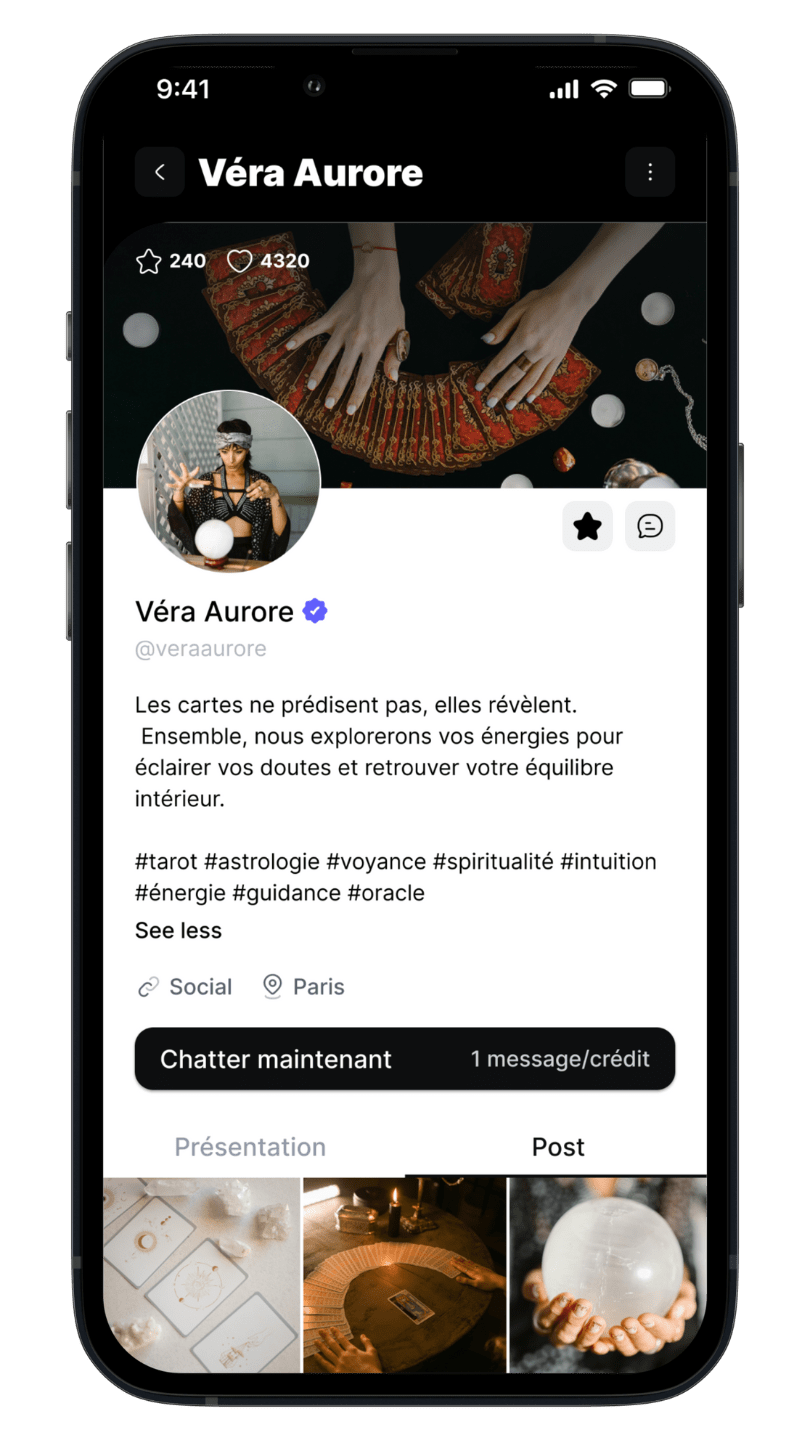
If you want to explore what your career decision stirs in you, Breeve offers personalized chat guidance. This is not a recruitment service: the advisor supports you in your thinking, without evaluating employers or deciding which offer to accept.
The process is simple: browse profiles, choose an advisor whose specialty speaks to you, then ask your question by message. You can mention what you hope to find in your next role and what makes the choice difficult. The exchange can help you articulate your expectations or consider your situation from another angle. You remain free to keep what seems relevant to you.
How Do You Choose a Profile Suited to a Career Question?
Compare the specialties, reviews, and availability shown on the profiles. These reference points help you find an advisor whose approach matches the topic you want to address. Profile information gives an overview of each person's experience and way of working, without guaranteeing that a particular response will suit your situation.
You could ask: "Which elements of these two offers deserve my attention given my professional goals?" A focused question helps keep the exchange connected to your path, rather than seeking a prediction or an instruction to follow to choose between two job offers.
What to Expect During a Breeve Chat Consultation?
You can express your thoughts gradually, refine your question, and choose the topics you want to address. New users receive 7 free messages. This introductory offer does not mean the service is free beyond that. Credits are only used for message exchanges and cannot be used for phone consultations. Guidance remains a support for reflection, not a promise of results: after the exchange, you can return to your notes and examine what aligns with your expectations.
To discover this approach in more detail, visit the page dedicated to intuitive and immediate chat guidance. You can move at your own pace and remain in control of your decision, without pressure.
Move Toward a Choice That Fits You
You do not need to be certain of everything to make a thoughtful choice. Instead, try to understand what each option makes possible, what it asks of you, and what matters most to you at this stage of your path. If hesitation remains, your intuition can complement your thinking, without replacing concrete elements or your own judgment.
Taking the time to choose between two job offers also means giving yourself the chance to decide according to your needs, rather than under the sole effect of pressure or fear of regret. The next step can be simple: reread your criteria, let your impressions settle, and, if it helps, ask your questions in a personalized exchange.
Can a psychic reading choose between two job offers for me?
No, the choice is yours. A consultation can help you consider a question from another angle, but it cannot determine for you which offer to accept. After the exchange, ask yourself which reflection seems truly useful and what you want to do with it. You can then decide while taking your situation into account, without treating an answer as an instruction.
How do I ask a psychic reading question about a career decision?
Ask a question that clarifies your thinking rather than requesting a prediction. You could ask: "What does this hesitation reveal about my expectations for the next stage of my path?" This wording focuses on your needs and motivations. To stay comfortable during the exchange, share only the necessary elements, without naming employers or sharing private information.
Do I need to believe in psychic readings to ask for chat guidance?
No, you can approach the exchange with curiosity, without adhering to any particular belief. Listen to the answers as avenues for reflection, then observe what they make you notice. One idea may seem relevant to you, while another does not match your experience. You do not need to force yourself to feel anything: your own assessment remains a valid reference point for deciding what to do next.
How long does a psychic chat reading last?
There is no fixed duration: you exchange at your own pace and can stop the conversation once you have clarified what you wanted to examine. To avoid scattering your focus, keep one main question in mind and note the ideas you want to reread later. This helps you notice what has evolved in your thinking, without forcing you to make an immediate decision at the end of the exchange.
How do I choose a psychic advisor for a work-related question?
Look for a profile whose specialties match your concern, then read their presentation to understand their approach. For a question about a career change, for example, look at profiles that address professional paths or life decisions. Reviews can provide an additional reference point; the exchange will then let you judge whether the answers help you think.
Does chat guidance guarantee making the right career choice?
No, it does not guarantee that your decision will be perfect and does not predict with certainty what will happen in a new job. To extend your thinking, imagine an ordinary day in each role, beyond the excitement of recruitment. Which tasks appeal to you? Which aspect would require lasting effort? These concrete questions can help you evaluate the insights received in light of your experience and expectations.