Developing Your Intuition with a Psychic Reader: A Practical Approach
Developing Your Intuition with a Psychic Reader: A Practical Approach
Developing your intuition with a psychic reader isn't about getting a ready-made answer, but about better understanding what's already happening within you. A chat exchange can help you put words to your impressions and examine them with perspective, offering paths to explore while you remain free to decide what resonates.
Published on:
15/10/2026
What if developing your intuition with a psychic reader wasn't about getting a ready-made answer, but about better understanding what's already happening within you? When your feelings mix with imagination or worry, it can be hard to know what to trust. You might also fear that a consultation will push you toward an interpretation or a choice that doesn't feel like you.
An exchange with a psychic reader can help you put words to your impressions and examine them with perspective. Guidance is neither a certainty nor an instruction: it opens paths that you remain free to keep or set aside. Your discernment keeps its full place.
Discover how to prepare for a consultation, express what you feel, and tell the difference between an intuition and a fear or an imagined scenario. The written chat format gives you time to formulate your question, reread the answers, and revisit your impressions. The goal is to gain clarity without giving up control of your decisions.
Key Points
Observe your impressions without immediately considering them as proof or predictions.
Rephrasing your feelings during an exchange can bring out the essential aspects of your question.
To develop your intuition with a psychic reader, keep your discernment: guidance suggests paths, it doesn't decide for you.
Start from a specific situation, then take the time to note and examine the impressions that emerge.
Written chat lets you ask your question and reread the answers at your own pace.
Developing Your Intuition with a Psychic Reader: What This Approach Means
In a period of doubt, an impression can seem strong one day, then lose its sharpness the next. Is it a premonition, a worry, or the desire for a situation to evolve? To develop your intuition with a psychic reader, start by distinguishing these possibilities: a feeling deserves to be observed, but it doesn't, on its own, constitute proof or a prediction.
Here, intuition refers to a personal, sometimes immediate, impression that you're trying to understand. It can draw your attention to a detail or bring out a reaction before you can explain it. The definition of intuition covers varied philosophical and psychological approaches. In daily life, the essential thing is to remain curious about what you feel, without automatically turning it into a certainty.
What's the difference between intuition and mediumship?
You can observe your intuitions by paying attention to your impressions and the context in which they appear. Mediumship refers to a specific practice: a psychic reader offers a reading or guidance based on perceptions associated with their practice. This doesn't mean that everyone possesses this ability, nor that an interpretation necessarily describes a verifiable reality.
The term clairvoyance often refers to an intuitive perception presented as going beyond information directly accessible through the senses. Words and their meanings vary according to practices. In a consultation, the issue is less about settling on a definition than examining what the interpretation evokes for you. Putting an impression into words can reveal a more precise question: what is really worrying you in this situation?
What a psychic reader can bring to your reflection
An exchange can offer you another angle on a personal situation. If you're hesitating to accept a new responsibility, you might ask: "What does this possibility stir up in me, and what aspects should I take the time to examine?" The answer doesn't predict whether you'll succeed and doesn't decide for you. It can rather lead you to consider your expectations, your hesitations, or the elements you hadn't yet formulated.
Consider the paths as proposals to be compared with your experience. Ask yourself if they correspond to facts you know, shed light on an emotion, or mainly arouse fear. You can keep an idea, set it aside, or reflect on it after the consultation. This perspective helps differentiate a useful reflection from an interpretation you might be tempted to follow without examining it.
Useful guidance illuminates your reflection without replacing your judgment. The psychic reader brings a reading, while you remain the person best placed to evaluate your experience, your priorities, and the concrete consequences of a choice. The place given to your discernment allows you to maintain a clear and personal approach.
How a Psychic Reader Can Help You Better Listen to Your Feelings
An exchange with a psychic reader can help you look at a situation from another angle, provided you keep your experience at the center. You explain what's worrying you; the psychic reader shares an interpretation or asks questions to help you clarify your feeling. The goal isn't to establish a definitive truth, but to bring out elements that you can then examine.
Rephrasing is useful for making a concern more precise. "I feel stuck" doesn't say the same thing as "I'm afraid of regretting a choice": the second sentence names a concrete worry. Describing your emotions, your hesitations, and the known facts helps separate what you feel from what you assume. Scientific research on intuition addresses how impressions can play a role in decision-making. This doesn't mean that a feeling is always accurate or sufficient for making a choice.
From a spontaneous impression to a clearer question
First, describe your impression as it presents itself, without having to explain it immediately: "This proposal attracts me and makes me nervous." Then transform it into an open question, for example: "What's at stake for me in this decision?" If you're hesitating about moving, the exchange can explore what this change represents for you, without announcing whether you'll leave or guaranteeing it will be the right choice.
A tarot or oracle card draw can serve as a support for the conversation. The cards present images or themes to interpret, which can spark personal associations. They don't guarantee a correct answer and don't prove what will happen. Their value depends on the reflections they open and how you connect the paths to your real situation.
The role of discernment during guidance
During the exchange, note the formulations that speak to you and those that don't correspond to your experience. An interpretation remains a hypothesis to consider; a verifiable fact can be compared with concrete elements. Ask yourself: "Does this describe an experience I recognize?" or "Is this one possibility among others?" You can question a path, set it aside, or come back to it later.
An impression gains clarity when placed back in its context and compared with your experience. To develop your intuition with a psychic reader, it's not about adopting all the answers, but observing what they bring out in you. If the written format suits you, a private chat consultation allows you to formulate your questions and reread the answers before forming your own opinion.
Personal Intuition or Guidance from a Psychic Reader: How to Keep Perspective
A psychic reader doesn't have to decide for you. Their role is to offer insight, not to choose for you or present an interpretation as a certainty. To develop your intuition with a psychic reader, keep a distinction in mind: your feeling is a personal experience, the psychic reader's reading is an interpretation, and a concrete fact can be verified independently. Confusing them risks giving too much weight to a single impression.
After a consultation, take a moment to classify what you've heard. "I feel tense at the idea of this change" describes a feeling; "this change will inevitably go badly" is an interpretation or a prediction. Practical elements, like the conditions of a new job, can be verified with appropriate sources. This distinction doesn't disqualify your intuition: it helps you make room for it without asking it to prove the future.
When to favor introspection, and when to ask for insight?
Introspection can be enough if you need to take stock calmly. Observe your thoughts, your emotions, and your reactions in different situations. Writing down what attracts you or holds you back can already reveal your priorities. If the same question keeps going in circles and you can no longer formulate it clearly, an exchange with a psychic reader can bring you a different angle to examine.
These two approaches can complement each other. First, reflect on what you feel, then use the consultation to explore a specific question. Then, reread your notes and compare the paths heard with your experience. This back-and-forth allows you to seek insight without delegating your decision. If the stakes are high, base your choices on concrete information and advice suited to the situation, rather than on a prediction.
How to recognize guidance that respects your freedom?
Respectful guidance leaves you the possibility to question, accept, or set aside an interpretation. Be wary of words that order you to act, make you feel guilty, or claim to guarantee an outcome. You must be able to take the time to reflect, without pressure to follow an instruction. A psychic reading consultation does not replace medical, legal, or financial advice, and a psychic reader must not substitute for competent professionals in these areas.
After the exchange, note separately what spoke to you, what doesn't correspond to your experience, and what you can verify in the facts. Then ask yourself if a path helps you better understand your priorities, without deciding for you. The checklist for a serious messaging-based psychic reading can also help you spot the signs of a reliable exchange that respects your autonomy.
The Steps to Develop Your Intuition with a Psychic Reader
A practical approach doesn't consist of looking for a sign in every detail or waiting for an absolute answer. It rather helps you follow the evolution of your reflection: what you felt before the exchange, the paths mentioned, then what seems relevant after a period of perspective. To develop your intuition with a psychic reader, start from a specific situation and keep a record of your impressions without reinterpreting them afterward.
Before the exchange: preparing a question and listening to your feeling
Before the consultation, take a few minutes to note the situation that worries you, the emotion it arouses, and the question that remains open. For example: "I'm thinking about changing jobs, I'm both attracted and worried. What does this hesitation teach me about my priorities?" This formulation invites you to explore your feeling, without asking for a definitive yes or no.
Avoid looking for an answer in every coincidence. If nothing seems clear to you, simply note this uncertainty. The goal isn't to manufacture an intuition, but to better identify what you're really experiencing.
During the exchange: keeping the thread of your question
During the consultation, come back to the prepared question if the conversation drifts away. Note the ideas or words that strike you, without immediately considering them as instructions. You can ask for a rephrasing or specify what doesn't correspond to your situation. Written chat makes note-taking easier and allows you to reread the answers before continuing your reflection.
To structure your approach, keep this sequence in mind:
Observe: describe your initial feeling and the context in which it appears.
Formulate: transform it into an open question, linked to a concrete situation.
Exchange: listen to the proposed paths and ask for clarification if necessary.
Note: record what resonates, what surprises you, and what remains uncertain.
Take perspective: reread your notes later and compare them with your experience and available facts.
After the exchange: integrating the paths without rewriting your memory
Reread your initial notes before adding your impressions after the consultation. This separation helps you distinguish what was already present from what emerged during the exchange, instead of unintentionally modifying the memory of your starting feeling. Differentiate the paths that seem useful to you from the elements you can't yet evaluate. You don't have to decide immediately.
Evaluate the usefulness of the consultation by the clarity it brings you: is your question more precise? Have you identified a priority or concrete information to verify? The result isn't measured by the accuracy of a prediction. Intuitive guidance by chat can extend the reflection around a personal question while leaving you in charge of what comes next. To explore this approach, chat with a psychic reader while keeping your question and your discernment at the center.
Developing Your Intuition with Breeve: A Chat Exchange at Your Own Pace
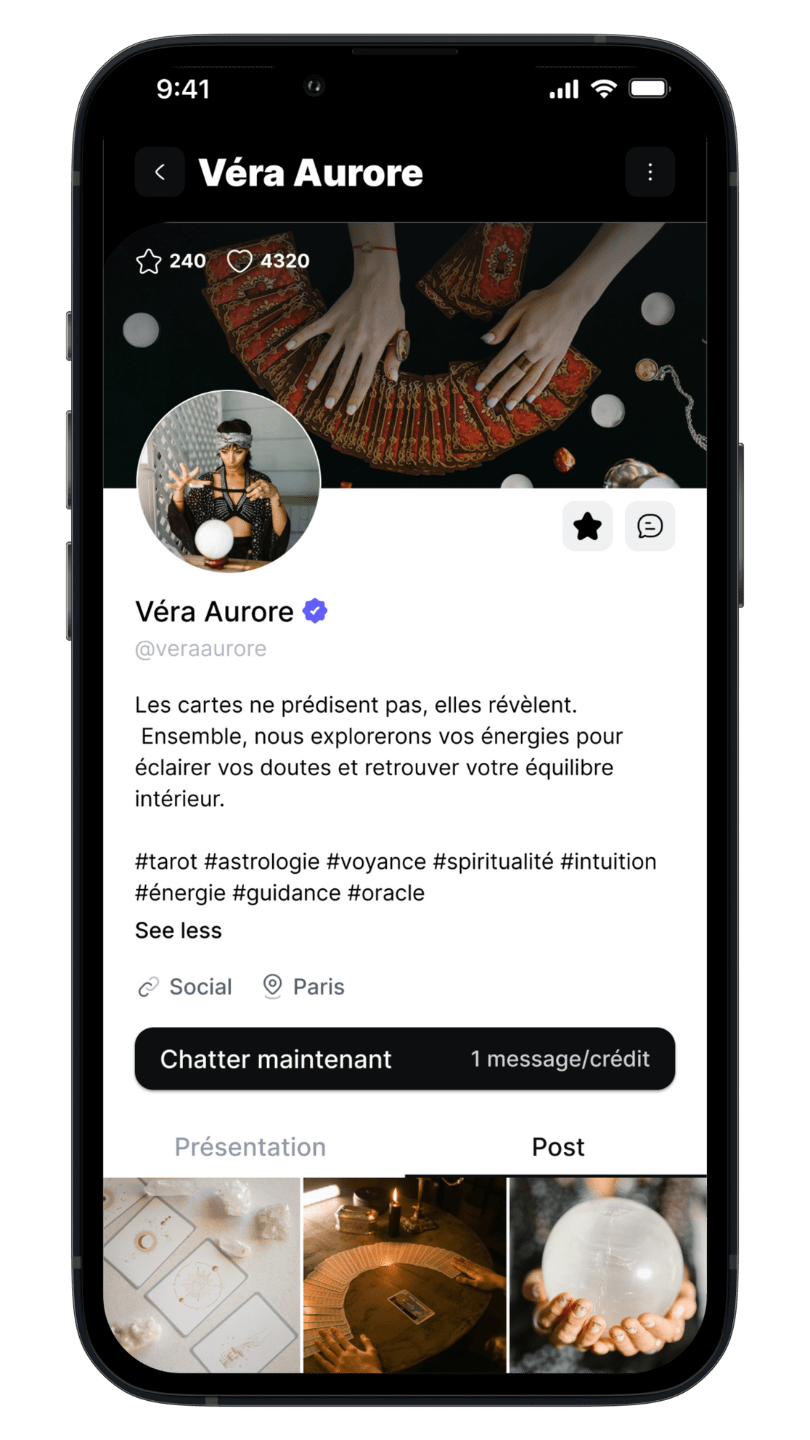
If you want to put your feelings into words without having to answer orally in the moment, chat can offer a suitable framework. Breeve connects users with certified psychic readers for private messaging consultations. You ask a question related to your situation and receive paths to examine. It's neither about obtaining a certainty nor entrusting your decision to someone else, but about taking a moment of reflection around what's worrying you.
The written format gives you time to clarify your thoughts, reread an answer, and revisit the words that caught your attention. You can thus distinguish the psychic reader's proposals from your own interpretation. This pace can be useful if you want to reflect before formulating a question or keep a record of the exchange to come back to later.
Why choose a psychic reading response by chat?
A psychic reading response by chat takes place through written messages, not in the form of a call. You can ask your question in your own words, then read the answers at your own pace. Private psychic reading by chat takes place in private, a format that can help you approach a personal question with more ease. You keep the thread of the exchange and can reread the important elements.
Before writing, choose a specific subject rather than a general request about your entire future. You can, for example, explain a hesitation in a relationship or a professional transition, then ask which paths deserve your attention. A targeted question helps guide the conversation, without imposing a single answer or predetermining the outcome.
A consultation as support, not as a final decision
A consultation can support your reflection, but it doesn't replace your judgment or the concrete information you need to decide. Breeve's certified psychic readers offer guidance in a private and confidential exchange; an interpretation remains a path, not a guarantee of results. Take the time to evaluate what corresponds to your experience, what raises a new question, and what doesn't feel right to you.
To develop your intuition with a psychic reader, move forward at your own pace: choose a question, read the answers with perspective, then decide for yourself what comes next. If you want to shed light on a personal situation in writing, chat with a psychic reader and keep your discernment at the center of the approach.
Make Your Next Question a Starting Point
Trust in your feelings is also built in daily life. Notice what catches your attention, what soothes you, or what makes you hesitate, without trying to draw an immediate conclusion. Let these observations accompany you and see over time which ones take on meaning in your life.
Developing your intuition with a psychic reader can be part of this personal approach. You don't need to have understood everything before starting an exchange: you can come with a question that's still evolving and clarify what you'd like to explore.
To open a space for reflection around a situation that matters to you, chat with a psychic reader. Take the first step at your own pace, with curiosity and kindness toward yourself.
Frequently Asked Questions About Intuition and Guidance from a Psychic Reader
Can you really develop your intuition with a psychic reader?
A consultation can help you better observe your reactions over time. To develop your intuition with a psychic reader, keep a journal: describe a situation, your first impression, and what happened next, without modifying your notes. Reread them after several experiences to identify the contexts where you feel more confident, without taking an isolated impression as a rule.
Do you need to have consulted before to talk with a psychic reader?
No, you can start without any prior experience. To feel more comfortable, prepare a few reference points: the subject you want to address, the important elements not to forget, and the themes you prefer to avoid. You don't need to tell your whole story or find a perfect formulation. A simple sentence about what's worrying you is enough to start the exchange.
Can a psychic reader make a decision for me?
No. Faced with a concrete choice, note the criteria that matter to you: your priorities, your constraints, and the information you're missing. Guidance can help you explore questions you hadn't considered, but your reflection can also rely on verifiable elements. For an important decision, take the time to compare the options rather than acting hastily.
How do I know if an impression comes from my intuition or my fear?
Ask yourself if the impression appears mainly in a specific context, for example after a disagreement or before a stressful deadline. Note what triggered it, then come back to it when the emotion has subsided. You can also look for another explanation and note the elements that support or contradict it. This examination doesn't give an automatic verdict, but helps avoid confusing felt urgency with certainty.
Can chat help me better understand my feelings?
Yes, you can structure your messages to make your question easier to explore. Briefly separate the context, your hesitation, and the point on which you want insight. If an answer contains several ideas, examine them one by one rather than trying to interpret everything at once. This way of writing makes the exchange more readable and helps you spot the questions that remain open.
What should I do if an interpretation doesn't feel right to me?
You can ask what, in your situation, led to this path, then check if it corresponds to the elements you know. If it doesn't help you, move on to another question or set this point aside. Returning to your initial notes a few days later can help you see if your opinion has changed or if the interpretation still finds no echo in your experience.



%20copie.jpg)
.jpg)

.jpg)

.jpg)

%20(1).png)
.png)
.png)


