

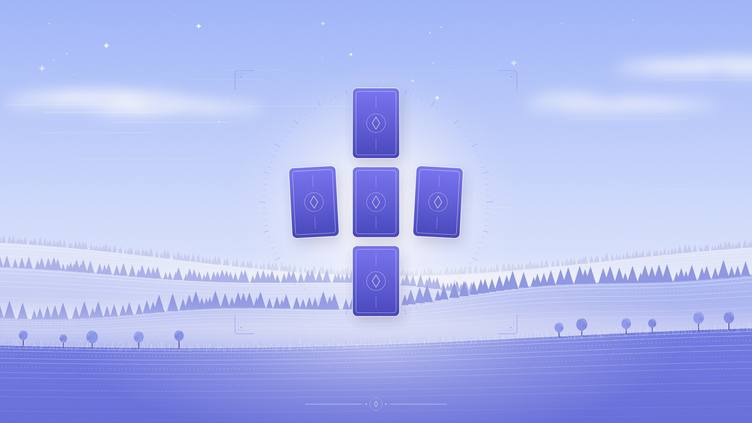
The cross tarot spread is a five-card method in which the cards are laid out in the shape of a cross. The left card describes the situation, the right card the obstacle, the top card what can help and the bottom card the possible outcome. The fifth card, in the centre, sums it all up. It’s used to shed light on a specific question.
It’s one of the most widely used spreads with the Marseille tarot, because it fits on a small table and can be read in a few minutes. Here’s the method, the meaning of each position, the versions you’ll come across and a complete example reading.
What is the cross tarot spread?
The cross spread arranges five cards along two lines. The horizontal line sets what’s working for you against what’s holding you back. The vertical line connects what can help you with where the situation seems to be heading. The centre brings everything together.
It’s not the Celtic Cross. That better-known spread, described by A. E. Waite in The Pictorial Key to the Tarot (1910), uses ten positions plus a card representing the person asking (Wikisource). The cross spread keeps just five cards, which makes it a good place to start.
It’s most often done with the 22 major arcana of the Marseille tarot, from the Magician to the World. Some readers use all 78 cards, a Rider-Waite-Smith deck, ordinary playing cards or an oracle deck. In the French tradition it’s sometimes called the ‘answer of Thoth’, a name that goes back to the 18th-century idea, put forward by Court de Gébelin and the Comte de Mellet, that tarot was an Egyptian book of Thoth. There is no evidence for that Egyptian lineage (Wikipedia, ‘Etteilla’). The guide to cartomancy tells where the idea came from.
How to do a cross spread, step by step
- Keep the 22 major arcana. Set aside the 56 minor arcana.
- Put your question into words. One open sentence, centred on you: ‘What’s holding me back in this project?’
- Shuffle the cards while thinking about your question, then cut the deck.
- Spread them face down and draw four cards, one at a time.
- Lay them out in a cross: the first on the left, the second on the right, the third at the top, the fourth at the bottom.
- Find the fifth card, in the centre: draw it, or work it out (method below).
- Turn them over and read each card in its place, then the whole.
Here’s the layout:
| Left | Centre | Right | |
|---|---|---|---|
| Top | 3. What helps | ||
| Middle | 1. The situation | 5. The summary | 2. The obstacle |
| Bottom | 4. The outcome |
What does each position in the cross spread mean?
The names of the positions vary from one author to another, but their logic stays the same. The table gives the most common reading, the one found in most books on the Marseille tarot.
| Position | Place | What it describes | The question it asks |
|---|---|---|---|
| 1 | Left | The situation, your state of mind, what’s working for you | Where are you now? |
| 2 | Right | The obstacle, what resists or stands in the way | What’s holding things back? |
| 3 | Top | What can help, a piece of advice, something new | What can you rely on? |
| 4 | Bottom | The possible outcome if nothing changes | Where is this heading? |
| 5 | Centre | The summary of the question | What should you take away? |
The same card changes meaning depending on where it falls. The Chariot, the card of movement, describes a situation that’s moving forward when it’s on the left. On the right, it can point to haste that gets in the way. At the bottom, it shows an outcome where things get going again.
The versions you’ll come across
Depending on the book or website, the positions don’t have the same names. Several schools exist side by side.
| Version | Left (1) | Right (2) | Top (3) | Bottom (4) | Centre (5) |
|---|---|---|---|---|---|
| For and against | For | Against | The current situation | The result | Calculated summary |
| Person and surroundings | The person asking | What they face | The problem to resolve | The result | Calculated summary |
| Situation and events | The situation | The obstacles | Events to come | The answer | The summary |
These three versions come from French tarot manuals and magazines, where the cross spread is a classic.
Choose a version before you draw, and stick to it. Changing the meaning of the positions after seeing the cards amounts to reading what you hope for.
How to work out the summary card
In the classic method, the fifth card isn’t drawn: it’s calculated.
- Add up the numbers of the four cards laid out.
- If the total is over 22, add its digits together. This is called reduction.
- Take the major arcana card with that number and place it in the centre.
Example: the Magician (1), the Empress (3), the Wheel of Fortune (10) and the Star (17). The total is 31. Reduce it: 3 + 1 = 4. The summary card is the Emperor (IIII).
Two cases raise questions. The Fool has no number: depending on the school, it counts as 0 or 22. If the summary falls on a card already in the spread, some readers reduce its number again, others keep it as it is.
One note on numbering: in the Marseille tarot, Justice is VIII and Strength is XI. Rider-Waite-Smith decks swap them (Strength VIII, Justice XI). The calculation here follows the Marseille order. The numbers of the 22 major arcana of the Marseille tarot are in the guide devoted to them, with the meaning of each one.
An example reading
Claire, 34, had an argument with her partner three weeks ago. Since then, they’ve barely spoken. Her question: ‘What’s been blocking things between us since our argument?’
| Position | Card | Reading |
|---|---|---|
| 1. The situation | The Moon (XVIII) | A hazy situation, things left unsaid on both sides |
| 2. The obstacle | The Hanged Man (XII) | Waiting: each is waiting for the other to make the first move |
| 3. What helps | The Empress (III) | Words, a simple and direct conversation |
| 4. The outcome | Temperance (XIIII) | Things settle down, if they start talking again |
| 5. The summary | Strength (XI) | 18 + 12 + 3 + 14 = 47, then 4 + 7 = 11 |
Read as a whole, the cross tells this story. The haziness comes from the silence after the argument. What holds things back is the waiting. What helps is speaking again. Strength, in the centre, speaks of quiet courage: making the first move without raising your voice.
The reading doesn’t say what Claire’s partner will do. It helps her see her own part and a way forward.
What question to ask the cross spread
The cross spread doesn’t work well with closed questions. It needs a question that leaves room for all five positions.
| Avoid | Prefer |
|---|---|
| ‘Will he message me?’ | ‘What’s going on between us at the moment?’ |
| ‘Will I get this job?’ | ‘How should I approach this interview?’ |
| ‘Is it the right choice?’ | ‘What’s making me hesitate between these two options?’ |
Three pointers for putting it into words:
- Talk about yourself, about what you can do, rather than what someone else will do.
- One question at a time. Two subjects in the same sentence blur the reading.
- Give a timeframe if the question needs one: ‘over the next three months’.
If the question involves an important decision, the guide How to make a decision suggests other methods to combine with a spread.
Read your own cards or ask for a reading?
Reading your own cards is a good exercise, but you often read what you fear or what you hope for. An outside view helps you spot what you’re missing, especially when the question is close to your heart. The guide How a psychic reading works describes how a session unfolds.
At Breeve, you ask your question to an advisor in writing, and the reply comes quickly. Your 7 free messages 🎁 are enough for a first question.

Find the clarity and answers you're looking for.





- Vetted advisors
- 94% satisfaction
- Replies in 1-2 min


8,000+ people guided in complete confidence
Frequently asked questions
Some traditions advise against certain days of the week. Most readers give common-sense advice instead: don't ask the same question again straight after a disappointing spread, avoid reading when you're in the grip of a strong emotion, and keep for the right professional the questions that belong to them.
Five. Four are drawn and laid out in a cross: left, right, top, bottom. The fifth, in the centre, is either drawn or worked out by adding up the numbers of the first four. Some versions stop at four cards, with no summary.
No. The Celtic Cross, set out by A. E. Waite in 1910, uses ten positions plus a card for the person asking. The cross spread uses five cards in a simple cross. It's quicker to lay out and easier to read when you're starting out.
Yes. The layout and the meaning of the positions stay the same. Only the summary calculation changes: it relies on the numbers of the tarot's major arcana. With playing cards or an oracle deck, you draw the fifth card instead of working it out.
It isn't designed for that. It describes a situation, what's holding it back, what can help and the direction it's taking. For a short answer, some readers use a three-card spread. An open question makes better use of the five positions of the cross.