

Cartomancy is the art of drawing cards and interpreting them to shed light on a question. It’s also called card reading. It uses an ordinary deck of playing cards, a tarot deck or an oracle deck. Each card has a meaning, and that meaning changes with its place in the spread. The practice took off in France in the late 18th century, and in English-speaking countries today it mostly means tarot.
Perhaps you’ve seen the word on a card reader’s sign, or you have a deck at home and don’t know where to start. Here’s what the practice covers, where it comes from and how a reading unfolds.
What is cartomancy?
The word joins ‘card’ to the Greek manteia, ‘divination’. Cartomancy means laying cards on a table, face up, in an order and pattern chosen in advance, then reading them. One of the earliest manuals, published in Paris in 1770 by a print seller who called himself Etteilla, already set out the essentials: a spread, and a set meaning for each card, upright or reversed (Etteilla, Wikipedia).
One point is often forgotten: the cards carry no universal message. The meaning given to a card comes from a tradition, a manual or the person reading. That’s why two card readers can read the same card differently.
There are two ways to practise:
- for yourself, by reading the cards on a personal question;
- for someone else, often called the querent, who brings their question to a card reader.
Where does cartomancy come from?
Cartomancy is more recent than you might think. Playing cards reached Europe in the 14th century and were first used for games. The oldest surviving tarot cards were painted in the mid-15th century for the rulers of the Duchy of Milan (Tarot, Wikipedia).
For reading the cards, the reliable traces date from the 18th century:
| Date | Milestone |
|---|---|
| 1770 | Jean-Baptiste Alliette, known as Etteilla, publishes in Paris Etteilla, ou manière de se récréer avec un jeu de cartes, a method for reading a 32-card deck |
| 1781 | Antoine Court de Gébelin presents tarot as an ancient Egyptian book, the ‘Book of Thoth’, in volume VIII of Le Monde primitif |
| 1783 | Etteilla publishes his first manual on tarot, Manière de se récréer avec le jeu de cartes nommées tarots |
| Napoleonic era | Marie Anne Lenormand (1772-1843) becomes the most famous card reader of her day in Paris |
| 1856 | The French card historian Romain Merlin coins the name ‘Tarot de Marseille’ |
| 1909 | The Rider-Waite tarot is published in London, and becomes the best-known deck in the English-speaking world |
Sources: Wikipedia, ‘Cartomancy’, ‘Etteilla’, ‘Antoine Court de Gébelin’, ‘Marie Anne Lenormand’, ‘Tarot of Marseilles’, ‘Rider-Waite Tarot’.
The idea that tarot came from Egypt has no historical basis. It comes from Court de Gébelin, and it shaped the whole tradition that followed. The decks sold under Mademoiselle Lenormand’s name were published after her death.
Cartomancy and tarot reading: what’s the difference?
Cartomancy covers any reading of cards. Tarot reading is one branch of it: it uses only the tarot.
| Cartomancy | Tarot reading | |
|---|---|---|
| Deck | Any deck: 52 or 32 playing cards, tarot, oracle | Tarot only, usually the Rider-Waite or the Tarot de Marseille |
| Number of cards | 52, 32, or however many the oracle has | 78 (22 major arcana and 56 minor arcana) |
| Approach | An answer to a specific question | Often a reflection on yourself, through the symbols |
| Practitioner | Card reader, cartomancer | Tarot reader |
In practice, the line is blurred. Many card readers switch from one deck to another depending on the question.
Which decks are used in cartomancy?
Three families of decks share the practice.
Playing cards
Reading ordinary playing cards was the most popular form of cartomancy in the 18th, 19th and 20th centuries. Most readers use the standard 52-card deck; in France, the 32-card piquet deck is the usual choice (Cartomancy, Wikipedia). In the tradition, each suit has its own area:
- hearts: feelings, family, loved ones;
- clubs: plans, work, what is moving forward;
- diamonds: news, travel, practical steps;
- spades: obstacles, tension, what holds you back.
The court cards (king, queen, jack) often stand for people around you.
Tarot
A tarot deck has 78 cards. The 22 major arcana, from the Fool to the World, carry the big themes: a choice, the end of a cycle, a fresh start. The 56 minor arcana are split into four suits: wands, cups, swords and pentacles (batons and coins in the Tarot de Marseille). In English-speaking countries, tarot is the most common form of cartomancy. The guide to the major arcana of the Tarot de Marseille explains each card.
Oracle decks
An oracle deck is made for divination, with its own number of cards and a booklet that gives their meanings. The best known is the ‘Petit Lenormand’, a deck of 36 illustrated cards named after Mademoiselle Lenormand and still widely used today (Marie Anne Lenormand, Wikipedia). Oracle decks are read more freely, because each card carries an explicit message.
How does a card reading unfold?
The gestures vary from one reader to another. Most follow these steps:
- Put the question into words. One clear, fairly open sentence: ‘What’s holding me back in this project?’ rather than ‘Will it work?’
- Shuffle the cards. The querent often shuffles them, then cuts the deck.
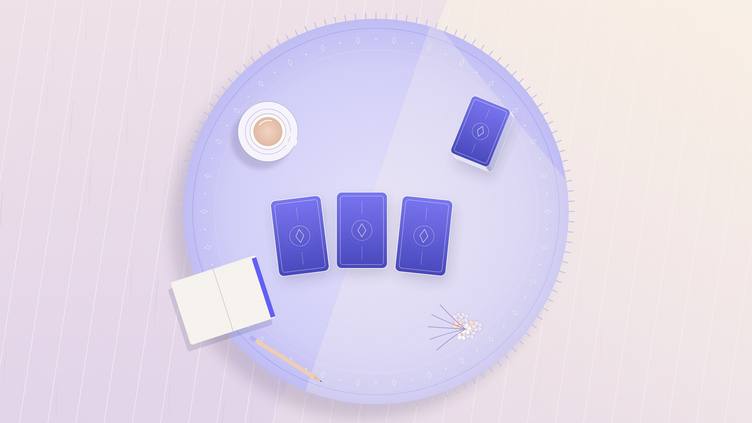
- Draw the cards. The method sets how many: one, three, five, sometimes more.
- Lay them out. Each position has a meaning: the situation, the obstacle, what helps, the possible outcome.
- Read the whole. Each card is read in its place, then the links between them.
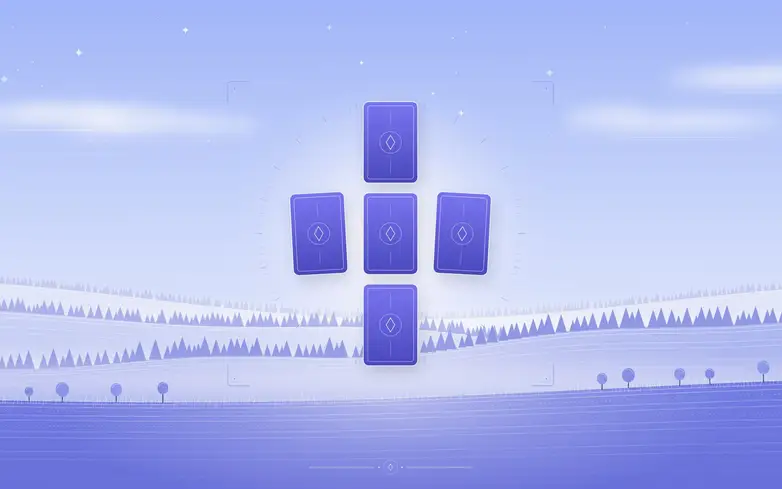
The cross spread, with five cards, is one of the most widely used methods. The guide to the cross tarot spread explains it step by step, with an example.
With a card reader, the session almost always starts with a conversation: the context, the people involved, what you want to understand. The guide How a psychic reading works describes how it goes in person, by phone and in writing.
What a card reader can shed light on, and what they can’t tell you
The questions people bring to the cards are mostly about feelings, work decisions and relationships with those close to them. A reading can help you:
- put words to a confusing situation;
- see what’s holding you back, and what’s pushing you forward;
- look at your question from another angle;
- prepare a decision you’re hesitating over.
It can’t give you a date, a certainty or another person’s decision. Readers themselves describe the cards as a picture of the situation at the moment of the reading, one that shifts with your choices. A good reading leaves you clearer about what you want to do. It doesn’t choose for you.
If your question is about the way you sense things, the guide How to develop your intuition may also help. And to place cartomancy among other practices, read What is clairvoyance?.
What question should you ask the cards?
Closed questions (‘Will he text me?’) leave little room for a reading. An open question gives more to work with:
- ‘What do I need to understand about this situation?’
- ‘What’s blocking things between us right now?’
- ‘What can I rely on to move this project forward?’
In writing, a few lines are enough: ‘I’ve worked for the same company for six years. I’ve been offered another role and I’m unsure. I’d like to understand what’s holding me back.’ The context, then what you’re trying to understand.
On Breeve, you ask an advisor your question in writing, and the answer comes quickly. Your 7 free messages 🎁 are enough for a first question.

Find the clarity and answers you're looking for.


- Vetted advisors
- 94% satisfaction
- Replies in 1-2 min


8,000+ people guided in complete confidence
Frequently asked questions
Yes, anyone can learn. Cartomancy rests on known rules: the meaning of each card, its place in the spread, the links between cards. It takes time to learn them, then practice to read a group of cards rather than one card on its own. Many people start by reading the cards for themselves.
People also say ‘card reading’ or ‘reading the cards’. With a tarot deck, most simply say ‘tarot reading’. Someone who practises it is a card reader, a tarot reader or, more formally, a cartomancer.
An ordinary 52-card deck is the easiest to find, and its four suits are quick to learn. Tarot takes more work, but its 22 major arcana are enough to start with. An oracle deck is read more freely, thanks to the booklet that comes with it. The right deck is the one whose pictures speak to you.
Tarot began as a card game, in northern Italy in the 15th century. It is still played in France and other parts of Europe. In English-speaking countries, where there is little tradition of tarot card games, most decks on sale are designed for reading. Using tarot to read the cards is only documented from the late 18th century.
A card reader works with cards: they read each card's meaning and its place in the spread. ‘Psychic’ is a broader word. It describes someone who says they perceive things without any tool, or who uses one, cards included. Many psychics also read cards.